
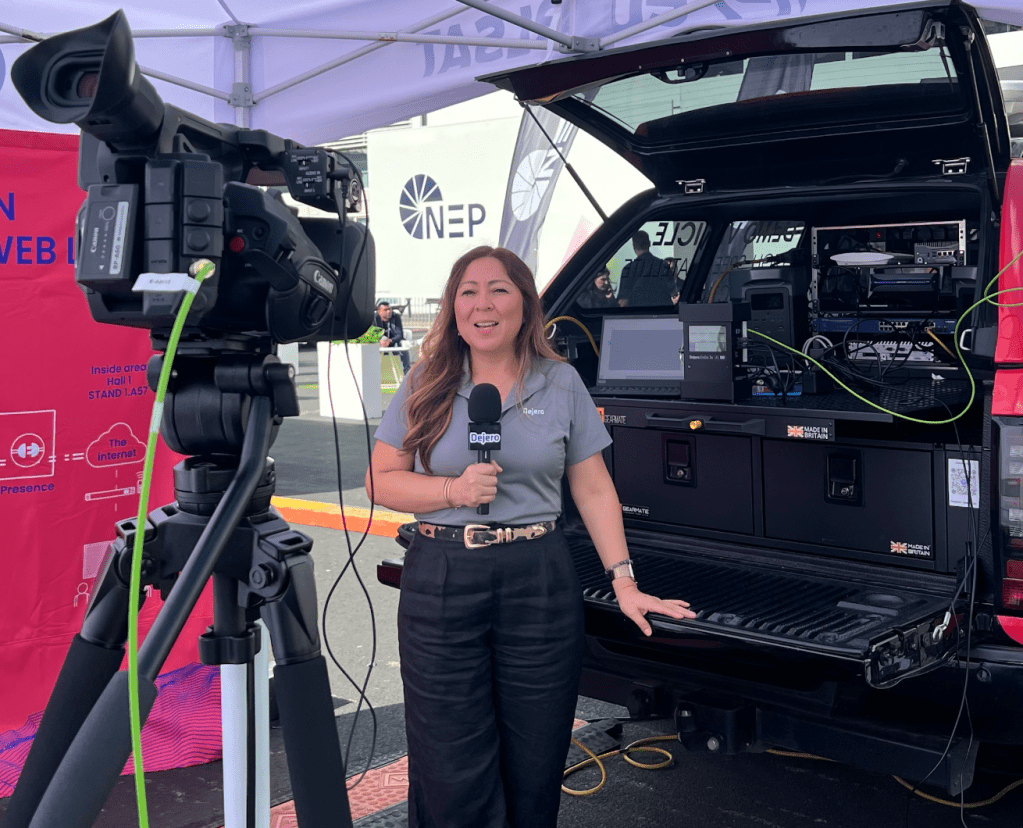
The broadcast industry loves to talk about innovation, but most “revolutionary” products are just incremental improvements to existing workflows. Real transformation happens when technologies stop competing and start collaborating. That’s exactly what I witnessed during our partnership demonstrations at IBC 2025 in Amsterdam.
As someone who’s built brand narratives around technology adoption for years, I’ve watched countless companies struggle to move beyond the “better mousetrap” mentality. You can engineer the most sophisticated encoder in the world, but if customers still need three different vendors, two integration specialists, and a prayer to make it work in the field, you’re not solving their actual problem.
The partnership imperative: Why going alone no longer works
Our collaboration with Eutelsat OneWeb proved this point dramatically. Dejero Smart Blending Technology™ alone is powerful—it intelligently combines multiple network connections for reliability. But when paired with Eutelsat’s LEO constellation, something transformative happens. Suddenly, you’re not just getting redundant connectivity; you’re getting global reach with terrestrial performance. You’re not buying a product; you’re accessing a capability that was previously impossible.
Workflow optimization through strategic integration
The magic happened when we stopped thinking about our EnGo 3x as a standalone encoder device and started positioning it as one optimized component in a complete broadcast ecosystem. Here’s what that looked like in practice:
Content creation layer: Professional cameras feeding into our EnGo 3x for multi-camera 4K encoding—handled with broadcast-grade quality in an ultra-portable form factor.
Connectivity layer: Smart Blending Technology intelligently managing multiple paths including Eutelsat’s LEO satellites and terrestrial cellular networks—ensuring reliability when individual connections struggle.
Production layer: Cloud-based production tools receiving pristine streams regardless of field location—enabling professional production workflows from anywhere.
Distribution layer: Seamless output to YouTube, LinkedIn, traditional broadcast, and emergency response networks simultaneously—maximizing reach without technical complexity.
Each component was optimized not just for its individual function, but for how it enhanced every other part of the workflow.
Beyond Amsterdam: What the industry response revealed
The response to our partnership demonstrations wasn’t just positive—it was strategically different. Instead of the typical IBC conversations about technical specifications and competitive comparisons, we found ourselves discussing transformation scenarios.
A major European broadcaster reached out within 48 hours, not to ask about our products, but to explore how the integrated ecosystem could reshape their remote coverage strategy. Emergency services coordinators from across Europe began mapping disaster response strategies around the total solution capability rather than individual tools.
The data tells the story: despite 36% fewer media mentions compared to 2024, we generated 45% more qualified leads. Why? Because we weren’t attracting casual browsers anymore. We were connecting with organizations actively seeking the specific solution that our partnership ecosystem delivered.
The strategic value of ecosystem thinking
From a brand perspective, this shift represents something fundamental. When you position yourself within a solution ecosystem rather than as an isolated product, several things happen:
Customer conversations evolve: Instead of justifying individual purchase decisions, customers start planning strategic transformations. They’re not buying equipment; they’re investing in capabilities.
Market positioning strengthens: Rather than competing on feature lists, you’re demonstrating unique value propositions that can’t be replicated by single-vendor approaches.
Partnership value multiplies: Each alliance doesn’t just add features—it exponentially increases the solution space you can address.
Sales cycles accelerate: When customers can visualize complete workflows rather than component integrations, decision-making becomes clearer and faster.
Beyond vanity metrics

The traditional trade show metrics would suggest our 2025 approach was less successful than previous years. Fewer media mentions, dramatically reduced reach numbers, lower video view counts. But digging deeper reveals the strategic transformation that occurred.
Our landing page engagement increased 746%—visitors spent over 5 minutes instead of 38 seconds exploring our content. Email click-through rates improved 10x for post-event follow-ups. Most importantly, the quality of conversations shifted from product inquiries to strategic planning discussions.
This validates something I’ve long believed: in B2B technology marketing, quality always trumps quantity. The partnership approach attracted fewer prospects overall but dramatically more qualified ones. We proved that focused, ecosystem-based messaging generates superior business outcomes even with lower traditional metrics.
The workflow revolution continues
What we demonstrated in Amsterdam was just the beginning. The ability to optimize every component of a broadcast workflow through strategic partnerships opens possibilities we’re only starting to explore.
Imagine news organizations that can deploy professional multi-camera coverage to any global location within hours, not days. Consider emergency response teams with unbreakable communications that work as well in disaster zones as they do in command centers. Think about content creators who can deliver broadcast-quality productions from locations that were previously technically impossible.
This isn’t about selling more products. It’s about enabling capabilities that reshape what’s possible in professional communications.
Building for the ecosystem era
For technology companies navigating this transition, the lesson from IBC 2025 is clear: the future belongs to organizations that think beyond their products to optimize complete customer workflows.
This requires different partnerships, different messaging, and different success metrics. It means measuring customer transformation rather than just technology adoption. It demands thinking about your role in enabling outcomes rather than just delivering features.
The broadcast industry has always been about storytelling. Now, the most powerful story we can tell is how strategic partnerships create capabilities that transform what’s possible for the storytellers themselves.
As we plan for what’s next, the question isn’t what new features we’ll develop—it’s which partnerships will unlock the workflows that will define the future of broadcast communications.



 CUERVOmedia
Leave a comment